Showing posts with label Revolution. Show all posts

Wednesday, 24 October 2012

Engaging Reverse


I'm not a religious chap. As an impressionable stripling I admit that I rather enjoyed religious education and readings from the Old Testament filled to the brim with tales of woe, water and wilful wanking. As I progressed through school, I found the greatest pleasure in teasing out its inconsistencies. My mid to late teens saw me finally eschew the supernatural and the illogical cobblers of The Bible and Erik Von Daniken with his caravan of alterneratii, for a solidly materialist perspective. The transition from impish ignorance to Montesquieuian maturation was an eurekan enlightenment transformational process not dissimilar to the Vulcan mating ritual of pon farr, which I assumed most people including Leonard Nimoy, went through.

In a way, I was lucky. My dad was an advocate of Marx's maxim of ruthlessly criticising everything that exists including my first pierced ear lobe. (1) Yet I recall him once telling me that he had reached a point in his life, that so dispirited was he that he'd seriously considered going into the Catholic church. I believe this was in response to the crisis of Stalinism in the USSR during the 1950s which created a series of internal crises of confidence for many communists. At the time I found it difficult to reconcile this admission with his Marxist views. It was only later that I began to understand how Stalinism had sowed political and ideological confusion widely and deeply throughout the left in the second half of the 20th century. With the international revolutionary left divided on the best organisational strategy to roll-back the juggernaut of neoliberalism currently bulldozing its way across the Mercator and through what remains of state-funded public services, it's clear that the dead weight of Stalinism still weighs heavily on the Marxist left. But it got me to thinking, which regular readers of this blog will know, is nearly always a bad thing.

An engaging chap

Jean Jacques Dessalines - kicked Napoleon's arse
and did more to end slavery than 

Abraham Lincoln and William Wilberforce
I recently stumbled across a 2011 article by Melvyn Bragg in the Telegraph on the King James Bible. Bragg is a great admirer of this lexicon of liturgy. Within this article, he dips a slender business finger into the sticky honey pot of common sense. Take for example, the matter of the abolition of slavery and one Mr William Wilberforce. Now I remember reading about slavery at school and Wilberforce featured in the abolitionist camp to some fine tune. And of course, only a poltroon of the highest abandon would denigrate Wilberforce's role in the wider campaign to abolish slavery. But where, I wondered, were the Quakers in Bragg's abolitionist schema? They did after all tirelessly campaign for abolition in Britain? Where was Thomas Clarkson? Clarkson did as much if not more than any other individual to raise in the wider consciousness the brutality and inhumanity of the trade in 'black skins'. He was also rather an adept organiser riding somewhere in the region of 35,000 miles on horseback, criss-crossing Britain, spreading the abolitionist word. While he was at it, he also took great pains to gather first hand testimony for the abolitionist cause whilst founding anti-slavery committees in whichever town he rested. What of Olaudah Equiano, a slave who earned his freedom and wrote a best-selling life story that was read by tens of thousands? Nor was there a nod towards the nationwide mass boycott of slave-grown sugar, which at its height was reputed to have involved around 300,000 people, being quite possibly the first PR based, mass consumer campaign.(2)

The beginning of the end

Finally, and most importantly, there is no mention of the slave uprising and the self emancipation from slavery by the slaves for the slaves, in the French slave colony of St Domingue (present day Haiti) led by Toussaint Louverture in 1791. It was the military success of Louverture (and after his capture Jean Jacques Dessalines) and the sheer bloody determination of the black slaves to free themselves and found their own free, self governing state which was to send shock waves around the pro-slavery world and bring this African holocaust to the beginning of its end. Abolition certainly wasn't brought to these oppressed by the warships of the British Royal Navy enforcing the belated will of the British Parliament nor in any of the speeches of William Wilberforce. There's a slight whiff  of a 'great men' reading of history in Bragg's view. We might also call it a common sense reading of the anti-slavery movement in Britain, and it's one I'm sure the Gove-ish right would positively endorse.

Maybe I'm being a little harsh. Lord Bragg is after all... well he's a Lord. He's a cultured chap, having curated the South Bank Show for many a year. One needs more than a modicum of intellect to wade in such culturally refined waters. But there's an overtone to this article and I can't help feeling it's ever so slightly hostile to the concept of 'reason' or more precisely what Bragg denotes as 'atheistic reason':

'I respect those who have no faith or little faith or are indifferent to it, but the current notion that atheistic reason marks the apotheosis of human intelligence, strikes me as being very doubtful. I’m as certain as I can be that there’s more to come.'

Lord Melvyn doesn't really elaborate on what this 'more to come' might be. Yet it's possible to divine from his words his real meaning and it's a word which carries with it a considerable degree of authority - it's the word 'belief'. As if to buttress his newly rekindled religious reawakening, Bragg calls up the names of Einstein, the Astronomer Royal Lord Rees and the physicist Stephen Hawking. He doesn't raise the name of one noted scientist Professor Richard Dawkins to reinforce his case for one very good reason. Dawkins' recent foray into the spume of what's been described 'militant atheism', is intrinsically hostile to Lord Braggs' personal view of faith. However Bragg is onto something when as it's reported, he 'poured scorn on the famous atheist's reliance on “reason” to destroy the Christian argument, insisting that faith was something that should be carefully examined.'

Dawkins: accepts that evolution goes only in one direction. 
What are his views on the establishment of a private
university which would appear to go in the 
other direction?

The Dawkins Delusion?

Here Bragg and I agree. I don't see there's much in the way of value in engaging in debates or long expositions with religious fanatics or leading churchtypes as a way to undermine religion and religious ideas. He might convince a largeish handful to reject their gods. However, US imperialism and its sponsorship of various Middle Eastern autocracies, the antics of it's best Zionist friend in that region and a few unmanned drones over Pakistan will inevitably create far greater numbers of radicalised religious adherents. The world's most advanced technological industrial economy is perfectly happy to co-exist, indeed encourage the rantings of the Christian fundamentalist right, a group not known for advocating progressive or liberal policies.

If Dawkins wants to see the back of religion, it aint gonna happen his way. So, if it's not Professor Dawkins militant atheism that exerts a tidal influence over serious numbers of humankinderies, what does? It's capitalism and religion - in that order. That religion can still command the loyalty of hundreds of millions of believers on the grounds of an idea, stands as a testament to the sheer flexibility of the various doctrines. To put it bluntly, if it didn't adapt, it wouldn't survive the titanic forces that it's exposed to on a daily basis by the hegemonic system of capitalism. Surely Professor Dawkins sees the immense irony in the persistence of organised religions and their concomitant religious ideologies within an inherently hostile environment, demonstrating in real time, the evolutionary theories he famously expounds?

Your eminently flexible friend

Religion is as globally relevant today as it was in the time of the First Crusade in 1096. It's inherent theological and textual flexibility allows adaptation, refinement and bespoke tailoring for the benefit of a dominant ruling class that a Saville Row suit maker would envy to the nth degree. Don't take my word. Look at the historical record which provides ample examples. Religion rarely if indeed ever, runs ahead of systemic socio-economic/political change. In fact the opposite is the case. The historical record shows us that established religious institutions and doctrines have acted like an fouled anchor chain on newly emerging systems of production and exchange. The friction created by this inertia has led to periods of intense social, economic and political contestation - they're called revolutions and their impact on society is usually profound. Take the English Revolution for example.

For God, for Queen King and for Country!

Our ancestors largely accepted the common sense that the monarch sat at the right hand of God. The pulpit and the sermon maintained and disseminated this prevailing wisdom across Europe and beyond. In consequence, European ordinary folk (usually poor and horribly exploited under an oppressive feudal system) suffered the whimsies of kings and tribulations often associated with monarchical absolutism. Between the years of 1640-60, a huge grass roots social movement developed in what we know today as Britain which attempted to dislodge this nugget of common sense with the not inconsiderable assistance of an army of russet-coated chaps and an executioner's chopping block. This process spread further with revolutions in America (1776), France (1789) and later two revolutions in Russia in 1917 which finally laid to rest the spectre of this type of absolutism in the West. It was a process which managed to remove by force of arms, God's divine fingers from of the plum duff of the political and economic sphere. These first three revolutions, although important for the promulgation of the enlightenment project, can be said to have provided the ideological and scientific foundations for capitalism to develop: they were firmly bourgeois revolutions.

Howzat: the first wicket keeper?
Cauldron of the revolution?

Despite the far-reaching consequences of these revolutions, they failed to completely eviscerate the church from the state, allowing it to re-root itself in the fertile soil of emerging bourgeois (capitalist) society. In Britain, Protestantism and later Methodism, proved eminently adaptable taking their place in the vanguard of unregulated industrialisation. Both demonstrated how religion could through a variety of twists and turns, continue to provide valuable services to capitalism particularly in the sphere of ideological control. And as Marx recognised, so often because of the propensity of capitalism to shift into overdrive in the 'race to the bottom', religion also acted as a salve on its worst excesses, providing a haven or 'a heart in a heartless world' to the impecunious individual.

Gandery sauce

Throughout history, to the oppressor and the oppressing minority class, religion provided a code by which to live (and importantly a schematic by which the majority 'others' should live). Yet for the oppressed, religion provides a common framework by which they may conceptually locate and thus interpret their own oppression. It can also provide the oppressed with a common language of resistance, and the means or an arena (the congregation or church) whereby radical or even revolutionary levelling ideas can be translated into direct actions:

" …a numberless crew of locusts have sprung out of the bottomless pit, assuming to themselves the names of Arians, Arminians, Socinians, Antinomians, Anabaptists, Familists, Antiscripturists, Antisabbatarians, Antitrinitarians, Libertines, Erastians, Levellers, Mortalists, Millenaries, Enthusiasts, Separatists, Semiseparatists, Quakers, and many more of the same brood … No country from the foundation of the world hath brought forth and brought up, so many monstrous births as it [England] hath done." (3)

Yet Bragg chooses to invert this schematic, putting the cart before the horse:

"There is much else that secularists, atheists and the indifferent choose to ignore in our history. This Bible inspired many great philanthropists, it gave purpose and support in the 19th century to the Bible Women and the Slum Sisters and the Sunday Schools, all of which took on the dispossessed and destitute in society and insisted on redemption and improvement. And there is more. But mostly we find other causes to explain these movements, and of course there were economic causes and political causes and the Enlightenment played an increasing part, but the King James Bible, the national book which fed so many of our great writers and gives us so much of our daily speech still, was the life force of much that makes the modern world."

Adapt and survive

Unlike Bragg's idealism, I see the motivations of the groups he mentions, as residing either in their guilt or self-interest, or for the more socially minded, based in their intrinsic humanity. African slaves, converted to Christianity on the plantations, hardly had need of a holy book to make them conscious of their own miserable oppression. That they framed it and their gradual but increasingly organised opposition to it in the religious language of the day, was premised upon their own interpretation of 'the Good Book' and the sermons of anti-slavery proselytes.

Yet what should we make of a body of theology that can with apparent ease, have an appeal for those at the top and bottom of society? Religion like nationalism, acts like reinforced concrete, setting hard in the interstices between contending class interests in societies. The structurated wooliness of religion presents the likes of Dawkins with an insurmountable obstacle: as long as class oppression exists, religion (in all its forms) will adapt and survive. I can provide a golden nugget of evidence straight from the horses mouth. Even in the face of the overwhelming body of scientific evidence that validates Darwin's evolutionary theories, the  Archbishop of Canterbury Rowan Williams in a 'public dialogue' with Richard Dawkins, can embrace evolution without fear of contradiction from a higher authority when he states that 'he believed that human beings had evolved from non-human ancestors but were nevertheless “in the image of God”.

Agar capitalism

The insurmountable problem Dawkins has to confront is not religion per se. It's the conditions that allow these superstitious anachronisms to persist and flourish. Simply put, in order to consign religion to the ash heap of history, one must also consign to the shitter-emptying-pit, the systemic causes of want, war, ignorance, poverty, exploitation and oppression in its multifarious guises - ie capitalism.

I'm no spring chicken. Nor is Lord Bragg. I'm nearer to the end than I am the beginning. Nor am I a churl of the first order of magnitude. I respect a person's right to 'believe' and to practice any religion or form of worship they so wish as long as they they're not trying to impose it on others, particularly when those others are me. Maybe his 'first steps back on the road to faith' provide him with some solace and warmth in realisation of his own mortality? Maybe this reverse rests on the apparent global hegemony of a liberalising capitalist system that appears to have seized the ideological high ground? I understand why it daily humiliates former left leaning intellectualites into an accommodation with the prevailing wisdom of 21st century. Yet I find it odd that the same forces should drive Lord Bragg into an apparent accommodation with the common sense of a bygone 17th century autocrat.

Notes and References

(1) Marx to Ruge Kreuznach, September 1843, sourced at http://www.marxists.org/archive/marx/works/1843/letters/43_09.htm
(2) Adam Hochschild, Bury the Chains, Mariner Books, 2006
(3) Thomas Hall 1660 sourced at http://faculty.history.wisc.edu/sommerville/367/367-072.htm


Usual disclaimer: This work is and expression of opinion on a matter of public interest and contains the opinions of the author. It is intended to report current events that are of public interest and public concern. The reproduction and use of any documents, photos and video images herein is to provide humour and accuracy in order to avoid civil litigation and claims of misquoting. In reporting current events they are used within the context of Fair Dealing or Fair Use. The author is happy to provide further acknowledgement if requested (email below). 

 The author also suggests that before embarking upon expensive civil actions for libel, contact the author. We have reams of documentary evidence which we are happy to provide. A right of reply also operates. We are also happy to make corrections and if necessary provide an apology. Email garypaulduke@gmail.com
Enhanced by Zemanta

Monday, 21 March 2011

My dear chap it doesn't just happen in Egypt - Join the picket lines this week!


Don't stay at home - why you shold join the picket lines!

This week and next will see UCU members in universities and colleges across the UK (March 24th in England) striking against attacks by the employers on pensions. Today lecturers in Scotland took strike action and lecturers in Wales are striking tomorrow (18th March). Vagrants have learned that lecturers at Warwick University were also peopling the picket lines today to defend their pensions and jobs. Why should lecturers strike? The fight for decent pensions is not some sort of abstract disagreement between employers and the UCU. Pensions are deferred pay. They're not gold plated. Gold plated pensions tend to inhabit the gilded corridors traversed by the likes of unelected bankers, Vice Chancellors and the CEOs of large concerns. Thus despite what BBC newsreaders and the Tories would have us believe pensions are an entitlement and not gifted to us by overly generous bosses. 

UCU general secretary, Sally Hunt, said: 'Staff at colleges and universities across the UK will be out on strike on Thursday 24 March in an unprecedented level of action across the further and higher education sectors. The attacks on staff's pensions, pay and job security have created real anger throughout the sector and instead of burying their heads in the sand the employers need to respond urgently to UCU's attempts to negotiate.'


The scales of justice weighed heavily in favour of
strike action by judges in France earlier this February 

Democracy from below and the importance of collective action

Staff at University of Salford will also be on strike on the 22nd of March. The Vagrants are pleased that Vice Chancellor Martin Hall has emailed staff in order to reaffirm that democracy is alive and kicking at the University of Salford. He informs us that the majority of those who participated in the recent ballot for industrial action voted for strike action. Like this Vagrant, Professor Hall has a clear commitment to the concept of liberal democracy and the notion of majority rule. It is indeed heartening to see university employees actively engaging in the grass roots participatory democracy within the union particularly when it centres on such important issues such as pensions, pay and jobs.

Deepening our democracy

But this democracy shouldn't cease the moment you've placed your cross on the ballot paper. UCU members should engage with non-members, explain to them why they're taking action and ask them to join the union and join them on the day. Indeed why stop with colleagues. Why not involve students as well. This strike is not just about pensions but the future health of Higher and Further Education. You'll be pushing at an open door as far as students are concerned. And in keeping with the spirit of extending liberal democratic values into the workplace wouldn't it be nice if all staff including senior managers, regardless of whether they are members of the UCU or not (or whether they voted or not) respected the will of the majority who voted and decided not to cross picket lines. I mean you might not vote in a general election but it doesn't mean you can reject the decisions and laws passed by Parliament does it? That would be vaguely anti-democratic wouldn't it?

Picket line fables and folklore galore

Picket lines are a great place to build solidarity, meet new colleagues, swap stories and absorb some of the picket line folklore that permeate universities across the country during periods of heightened militancy. You might even hear the hoary old urban myth of the conscientious manager, possibly a poor old Dean or Head of School, desperate to demonstrate their commitment to collective action and the plight of their colleagues by resigning from their union in order to cross a picket line. It's certainly done the rounds.

Time to join the union

Indeed, for those who have not yet joined the UCU (and other campus unions) what better time, under the shadow of a finely honed axe poised menacingly over several hundred jobs. What is clear is that if it falls, its keen edge will not discriminate between members and non-members of trade unions. And on this note, today in a wonderful show of solidarity, students at Edinburgh University went into occupation in support of striking Scottish teaching staff. There is a growing awareness among both students and university workers that the protests against fees and the strikes against the attacks on pensions, conditions and job losses are one and the same.

Edinburgh student occupy in solidarity with striking lecturers last week
A Vagrant's life can be a lonely life

We Vagrants by our very nature are often isolated from wider society... in Beckerian terms we're 'outsiders'. When the opportunity arises to indulge in a little collective endeavour, we grasp it eagerly with our grimy hands. The mass movements that exploded onto the world stage driven by the Egyptian and Tunisian masses in first two months of 2011 have demonstrated that collective struggle is firmly back on the agenda.  This week's strikes are therefore part of the larger global opposition to driving down our standards of living  in the now and the future (lower pension benefits) and driving up the profits of the already super-rich. We have a world to win or a lot to lose. Next to this, the thinly veiled threats of pecuniary loss should be seen for what they are - a clear indication that when push comes to shove, those at the top table are not really our friends and that they're more than a little rattled at the prospect of what our own collective endeavour might bring.


For those who do brave the elements, a picket line is an exciting place.  This Vagrant will be joining those out on the picket lines at Salford on Thursday. As strikes rarely garner much positive commentary on the television news or in the press, we have provided a little demonstration of wider action and solidarity among colleagues across the country happening this week.

Oh and by the way, don't forget to book your seat for what promises to be a huge demonstration against the Tory cuts in London this Saturday.

The full list of Universities that are out 17-22 March is below

The University of Aberdeen
Aberystwyth University
University of Bangor
University of Bath
Queen's University of Belfast
University of London, Birkbeck College
The University of Birmingham
University of Bradford
University of Bristol
Brunel University
University of Cambridge
Cardiff University
City University
Courtauld Institute of Art
Cranfield University
The University of Dundee
Durham University
University of East Anglia
University of Edinburgh
University of Essex
University of Exeter
The University of Glasgow
University of London, Goldsmiths
Heriot-Watt University
The University of Hull
Imperial College London
University of London, Institute of Education
The University of Kent
King's College London
University of Wales Lampeter
University of Lancaster
The University of Leeds
University of Leicester
University of Liverpool
London School of Hygiene and Tropical Medicine
London School of Economics
Loughborough University
LSTM
The University of Manchester
Newcastle University
The University of Nottingham
Open University
University of Oxford
University of London, Queen Mary
University of Reading
Royal College of Art
University of London, Royal Holloway
The University of Salford
University of London, School of Pharmacy
University of London, Senate House
The University of Sheffield
University of London, SOAS
University of Southampton
University of St Andrews
The University of Stirling
University of Strathclyde
University of Surrey
University of Sussex
Swansea University
University of Ulster
University College London
University of Warwick
University of York

Universities still finalising details of their action because of holiday dates:

Durham University
Newcastle University
Institute of Education
University of Cambridge
University of Oxford
University of Sussex
University of Warwick
Enhanced by Zemanta

Monday, 14 February 2011

A funny thing happened on the way to the revolution...

Ancient Egypt's post-industrial paradigm meant
this Pharaoh had to build the pyramids by himself

Recent events in Tunisia and Egypt are an enduring reminder that revolution continues to play a central role in a globalised world despite the many epitaphs and obituaries afforded to it by academics, political pundits and the literary mouthpieces for global US domination.

The spectacle of Western political elites such as David Cameron, Hillary Clinton and Barak Obama, lining up to publicly affirm their commitment to liberal democracy and their obvious sincerity in their wish to see democracy take root in Tunisia and Egypt is only marginally preposterous when we consider the public and political support that these Western 'democracies' have consistently provided to the very same leaders and regimes. While Mubarak and Ben Ali murdered, imprisoned, tortured their own civilian populations, the US and UK governments punished them with trade deals and rather large sums  in US aid ($1.3 billion a year according to The Guardian).(1) Despite the attempts of previous British and US administrations to bring down Mubarak by the use of extreme friendship, it took the active engagement of a non-friendship strategy and the democratic mobilisation of hundreds of thousands if not millions to end his rule.

The cacophony of the democratic 'transitionals'

Although somewhat a sceptic when it comes to believing anything reported in the mainstream media, this writer thought it a little odd that some journalists should feel a little in the way of surprised that a little hostility had been shown to them by the crowds. To anyone with half filled cranium, one might have viewed this as perfectly understandable given the above support of the British and US for the soon-to-be-vanquished dictator and his bloodthirsty state machine. That the press have to a considerable degree indulged in the same sort of cack-fence-hand-balancing act that has characterised Cameron's recent vacillatory bleatings has not been lost on the ordinary Egyptian activist.

At the root of this is the West's concern that the usurption of their man in Egypt may not sufficiently dissipate the anger and opposition of the mass of Egyptians, and may act as a brake on the formulation of any government sympathetic to Western aims in the region. One other paragon of democratic delight in the region is also mightily concerned as should be the case. The expansionist state of Israel, which represents such a healthy example of what a vibrant democracy and economy should look like, that it stolidly refuses to accept the $3 billion or so in aid dished out to it by the US government every year is taking recent events very seriously indeed.(2) The Egyptian regime has been a vital ally of Israel. Without the pro-Israeli Anwar Sadat and his successor Mubarak, it is unlikely that Israel would have been able to consolidate its positions in the Occupied Territories, wage a bloody war or two against another democracy in the region - Lebanon - and commit gross human rights atrocities daily against the Palestinian peoples to say nothing of its war crimes against the population of Gaza. Thus politicians of all colours and the Western media are pushing the idea of 'transition' which for them means business as usual, and for the Egyptians, after a few democratic frills and thrills have been added to their creaking constitution, back to the business of squeezing every last drop of profit from Egyptian workers which brings us nicely to the point of this article.

Apparently, due to a shift from industrial to knowledge
production and services, this lot don't exist anymore
(striking textile workers Malhalla el-Kubra 2009)
What's that you say... the working class... not in my post-industrial paradigm!

There is however a more fundamental problem for Western political and business leaders which has loomed like veritable spectre that may yet return to haunt Europe. They are currently busy ramming home neoliberal policies and massive cuts in social provision across Europe (Greece, Ireland, Spain, Portugal and the UK) in order to stave off economic collapse and further enrich the already rich at our expense. Mubarak's been in the vanguard of a similar set of policies which he's been happily visiting on his own people for decades, like some latter day global reincarnation of the Exodian plagues. Thus, the speed with which events in Tunisia and Algeria hopped across North Africa showing utter disdain for national borders and engulfed Egypt, has sent a shiver down the collective spines (if one might be found) among the Western ruling classes. It would appear that Trotsky's theories on permanent revolution have never been so apposite.

Post-industrialism -  a theory of the middle class by the middle class, for the middle class

There has been a corollary in the forcing of the Washington Consensus policies down the publics' collective throats for decades. They have also been ideologically bludgeoned into accepting the common sense notion that the working class as a force for revolutionary change in the world, belongs to a long-buried past. It's a past lazily epitomised by many now-cynical once left-ish academics and vox-pop political commentators as the failed 'actually existing socialism' and 'communist' experiment of the former USSR and its satellite states of Eastern Europe. For much of the press and media, because of the almost hegemonic status of this view, this most recent (and ongoing) revolution must therefore be characterised as 'middle class' because to them, the 'other lot' only inhabit the footnotes in dusty tomes in the British Library or have slipped down the social scale and now inhabit a Sub-Dickensian cider-sodden underworld  three clicks away from Cannery Row referred to increasingly by the same media types and social analysts as 'the underclass'. Besides, if we believed the press, the entire revolution was achieved by a single FaceBook savvy post-graduate with a laptop and over-ambitious sebaceous glands.

This is not to willfully avoid the obvious fact that much mass middle class discontent (unemployment and the end of 'jobs for life' in the civil service for middle class university graduates) has played an important role within the revolution. Rare are the revolutions that consist of a single class actor. But how often have we been told by the likes of Ronald Inglehart and his merry band of post-materialists that it's by and large the working class whose demands tend to centre on the material while the middle classes protest about the environment, nuclear disarmament and chlorine-free tampons?

The roots of the revolution

Yet the recent social mass explosion that has led to Mubarak's political demise, should not be seen in isolation nor as the consequence of the ire of an increasingly disenfranchised and powerless middle class. It should viewed as an extension of mass working class opposition to both the regime and the neoliberal policies of the West eagerly pursued by Mubarak resulting in increasing numbers of strikes that have raged in the industrial centres of Egypt for many years. "What rot! Why haven't we heard about these strikes?" I hear you chime. It's quite elementary my dear Watsons.  It's a sort of self-fulfilling logic (based on simple cause and effect) which goes something like this: because the working class no longer exist or at best, are few in number, why report the activities of a small minority. People have money in their pockets, may own their own homes (ex-council) have computers, mobile phones and go on holiday at least once a year. It's a very good indicator to social mobility. We're all middle class! (or at least lower-middle class). Thus reporting working class strikes isn't particularly relevant or popular (and might give people the wrong idea) and as such, they're about as welcome on the BBC teatime news or Newsnight as a poorly timed methaneous emission at a canary testing factory. Rare unless it happens to be on British Airways and has a detrimental impact on the holiday plans of social class grade B and C1.

British Airways cabin crews prior
to being post-industrialised out of history
Malhalla el-Where?

So it's no surprise that the wave of strikes that have defined Egypt for the past three to four years, particularly around the huge textile mills of Mahalla el-Kubra,(3) have made hardly a dent in the scheduling of BBC news or the wider press. Why would reporters wish to cover this? Strikes are only ever about material things after all - 'knife and fork' issues. They're never political are they? It's a general rule of thumb among many used to determine what's newsworthy and what's not concerning all things industrial. And it is of course entirely wrong. And exactly who are these people who the 'determining'... the people who have not only accepted the 'post-industrial' paradigm but have acted as the vanguard in convincing us that the working class really have 'ceased to be' in cod Cleesian terminology? They accept the ideology and feel the need to convince us the same should we feel the need to organise and resist the magnetic attraction of this perfectly natural phenomenon known as 'the market'. As most are drawn from the middle class, educated at the elite universities such as Cambridge and Oxford, they rarely go on strike. It's hardly surprising that they should hold such views. Besides, they don't want their weekend breaks ruined in a bout of wildcat action by baggage handlers at Stanstead.

The new middle class
But the evidence shows that that the Egyptian working class have consistently been at the forefront of the fightback against the state, rising prices, unemployment and for key political demands for many years. Alexander has written extensively on the importance of working class resistance to the market reforms of the Mubarak regime and provides in her analysis a level of continuity between events over the last few years and those of today.(4) Their actions have provided the space for such recent political demands to be formulated. They have consistently confronted Mubarak's state repressive apparatus head-on and have given wider Egyptian society (with the Tunisian masses) the confidence to take on the state machinery. In contrast, the FaceBook analyses provided by the Oxbridge elites and political journos and commentators have proved largely ahistorical and frankly wanting.

An example to test this ridiculous assumption

Last weekend (5-6th Feb), the British news media appeared to have placed the Egyptian revolution lower down its list of priorities for reportage. Indeed, after the violence of the counter-revolution in the guise of the plain clothes police thugs and pro-Mubarak supporters on camel-back charging through the throng, if one was to believe much of the news coverage, it was all pretty much over and the most that the protesters could expect was many more months of Mubarak in power until a orderly 'transition' to civilian rule could be organised. Yet within one or two days, with the spreading of strikes across Egypt and the active participation of the working classes in the vanguard of the protest movement (it was noted on the BBC news around the same time how many middle class activists had been driven from Tahrir Square by the violence of the pro-Mubarak forces who had taken the streets, to be replaced by even greater numbers of workers)(5)

Enter the dragon

By Tuesday and Wednesday it had all changed. BBC news reporters and the press had switched from endless pictures of mass humanity in Tahrir Square to pictures of striking workers on the Suez Canal,(6) to reporting strikes by doctors, lawyers (the respectable end of the strike movement) striking rail and public transport workers.(7) In Cairo, hundreds of 'electricity workers stood in front of the South Cairo Electricity Company, demanding the ousting of its director.'(8) Few could deny the political relevance of this act against a government appointed bureaucrat of a state-owned company. Railway workers wishing to strike across the country were asked to remain at work to enable protesters to travel by rail to the major protests being organised, a striking example if any of the potential power of sections of the working class in 'post-industrial' society.(9) With the growing participation of increasing numbers of striking workers in key industries, the movement was emboldened, given a fresh impetus and wielded real power.(10)


The same old tears...

The example of events in Tunisia and Egypt are there for us to draw from and learn. This will not be lost on our own ruling political elites (and the elites who exert dominance over every minute of our lives but are never elected - the capitalist ruling class and the unaccountable managerial elites who exercise power on their behalf) who behind the cloak of 'democratic legitimacy', savage our welfare, health and education systems, throw hundred of thousands on the scrapheap and impose more WTO and World Bank prescriptive measures upon us in the form of sell-offs and forced privatisations. Expect a tightening up of the British legal system as our own homegrown security police apparatus adopt the 'Mubarak methodology' as tens and hundreds of thousands take to the streets to oppose to these vicious and damaging policies.


TUC Demonstration Against Cuts, Saturday 26th March 2011, assemble 11am Victoria Embankment, London, march to rally in Hyde Park,
As such, it is beholden upon us to join our Egyptian brothers and sisters and exhort our trade union branches to provide coaches for the Demonstration Against Cuts.


(1) Source The Guardian, Friday 4th Feb 2011, http://www.guardian.co.uk/world/2011/feb/04/egypt-protests-us-military-aid
(2) Counterpunch sourced at http://www.counterpunch.org/christison03052009.html
(3) Sourced at http://www.arabawy.org/2009/07/15/egypt-workers-fight-for-pay-and-against-the-state/
(4) Alexander A, Inside Egypt's Mass Strikes, International Socialism Journal, 03 March 2008 sourced at http://www.isj.org.uk/?id=428
(5) Source The Economist at http://www.economist.com/node/18063746
(6) Sourced at http://wallstreetpit.com/61006-suez-canal-workers-go-on-strike
(7) Sourced at http://www.upi.com/Top_News/World-News/2011/02/09/Rail-workers-strike-in-Egypt/UPI-23911297278607/
(8) The Globe and Mail, Feb 09 2011, sourced at http://www.theglobeandmail.com/news/world/crisis-in-egypt/workers-strike-as-egyptian-uprising-moves-to-second-stage/article1901299/
(9)Sourced at http://www.jpost.com/MiddleEast/Article.aspx?id=207693&R=R3
(10) Tehran Times 11 Feb 2011, sourced at http://www.upi.com/Top_News/World-News/2011/02/09/Rail-workers-strike-in-Egypt/UPI-23911297278607/

Wednesday, 10 November 2010

Oh Mr Porter!


Isn't it odd how the Press Association, the BBC and other media see the world? A few members of the British armed forces marching a thousand miles to raise money for the British Legion is seen as a thoroughly positive thing (putting aside for one moment the sticky question of why these wounded 'heroes' who have fought to promote British interests abroad have to rely on charity in the first place). This is pumped out to such a degree that its intrinsic 'rightness' has been absorbed into our collective DNA. An example might be the raising of vast amounts of money through clever little devices or mechanisms such as financial appeals like Help for Heroes or the musical manoeuvres performed by highly talented songers known as 'The Soldiers'.

They're heroes and they're doing a great job...
Charity begins at home

This type of militarisation of society is seen in mediaworld as not only necessary but as a fitting tribute to 'our boys' who are after all, only doing a 'job'. The rising frequency with which these types of images or stories are portrayed on our TV screens some cynical types might argue, is designed to counter negative portrayal of war, the mass opposition to it and the increasing frequency with which the dead and maimed are being boxed up and sent back to the UK. The by-now monotonous regularity with which our screens are filled with the happy-clapping mourners of Wootton Bassett who for some vague reason have taken it upon themselves to act as the nation's carpideiras who see it as their personal moral duty to help 'repatriate' the dead on our behalf.

...apparently 
Rarely mentioned are the tens of thousands of Iraqis or Afghans maimed or slaughtered by 'our boys'. This violence is of course perfectly acceptable because it is conducted under the rules of engagement and as part of the War on Terror. The British troops and their allies are killing to ensure that we can travel on public transport without ourselves being killed. This they do with a well-trained eye on the handbook of war, conducting their campaigns according to very strict guidelines never wittingly targeting civilians. If there are civilian deaths or casualties they are usually reported as 'unfortunate' mistakes or unavoidable 'collateral damage'. If the innocent casualties now and again manage to garner some scrap of airtime, those who take up arms and oppose the invading armies - whatever you wish to call them - suffer singing-from-the-same-hymn-sheet opprobrium. The violence of everyday warfare is very deftly given a makeover that would make style guru Gok Wan fashionably lime green with envy.

This chap's foot made more impact media-wise
than the considerable talents of the
king of the NUS Aaron Porter
Contrast the supine reportage of this sort of state violence to that conducted by a few hundred students angry at the dismantling of state funded university education. The BBC news, Boris Johnson, Channel 4 et al, spoke with one voice in their condemnation of the 'violence'. Of course, those heaving in the windows of Tory HQ couldn't have been the darling progeny of the middle class could they? It must have been organised and led by 'anarchists' or according to one BBC reporter well versed in the use of the Marxist dialectic, the 'Socialist Workers Party'. How did she reach this compelling and incontrovertible truth? Its elementary dear Watson. She'd seen them selling papers earlier on the demo. Ah if only life were as simple as her.

You read it here first

As predicted on this blog last week, students in the UK, fed up with annually strolling around London shouting, have decided to take a leaf out of their French and Greek counterparts' book. They are rightly angry that Nick Clegg lied to them and is helping the Tories hike fees up to an unaffordable level for even the well healed. Some of the more politically advanced students are less than happy with having to pay the bill for an increasingly bankrupt capitalist system that puts profits of corporations before public services and the very notion of a 'public good'. Far from condemning these students, we should be congratulating them. They are undoubtedly the vanguard and a portent of the very near future. They also made sure the demonstration got airtime. If anyone should be condemned it should be that awful excuse for student leadership epitomised by the frightened-of-his-own-shadow Aaron Porter, NUS President. It is the view of this author that this man has all the credentials for a potential future within the ranks of the New Labour hierarchy.

Students... they're lazy, smelly,  long-haired sods!
The press will no doubt over the next day or so, roll out a few vox pop types: over fifty five, grey haired and disgruntled,* who like Mr Porter will without a second thought, condemn the violence of the students. Our generic pre-retirement chap, chafing at the gusset because he's being forced to suffer two years of extra post-retirement harassment from his boss who he thinks is a bald vindictive bastard, will without an original first thought add  that "they should bring back national service". He will not of course consider for one moment the irony in his rather reactionary and ridiculous demand.

*This author is professionally qualified to take the piss out of grey-haired types having been endowed with a fine grey mane. 
For the sake of not wishing to be sued for libel a second time, all the above is nothing more than the opinion of the author and contains no 'facts' whatsoever.

Tuesday, 2 November 2010

Student Protests - the Green Shoots of Recovery?

Children of the revolution in Bolan-esque terms
Students at the London School of Economics are planning to protest today against a visit by Energy Secretary and Coalition minister Chris Huhne. Students are opposing plans to raise student fees. The protest also appears to have the solid backing of the National Union of Students (NUS). This has the potential to be the start of a shift forward in terms of the dynamics of the student protest in the UK, organising collectively to fight the cuts in HE and the imposition of higher fees.

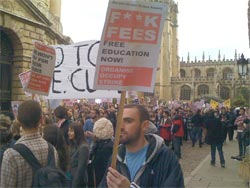
This follows a successful protest last Thursday in Oxford by students who forced Vince Cable to cancel his visit to the University. The protest in Oxford was partly built through a Facebook page which attracted considerable interest. Around 1,500 students, members of the public and trade unionists brought traffic to a standstill in Oxford on more than one occasion despite the best intentions of the police to scupper their plans.

The stopping of traffic....! how dare they. This brings back memories of our own campaign at the University of Salford two years ago. A series of protests, with one stopping traffic at rush hour, demonstrated how students and staff could begin to organise in opposing unpopular savage cuts to courses and staff.

Students protesting against Vince cable (Photo J Pitman)

The NUS and leadership skills

Since the introduction of tuition fees by a Labour government, the NUS have largely been half-hearted in their opposition to fees. There have been some sizeable and angry protests in London in the past especially when fees were first introduced. This author went on many coaches to Londinium and broke through countless police lines in order to lay claim to the London streets in the name of free education.

But the campaign quickly became much like an annual chore that had to be organised to keep up appearances. The NUS leadership now have the chance to place themselves at the centre of opposition to the privatisation of HE. It needs to take a leaf out of the 'green shoots' of student protest recovery in France and coordinate campaigns with the trade unions much like the students have in Greece. The protests also need to be linked up with students in the FE colleges who are also being attacked with cuts in the Education Maintenance Allowance (EMA). Thousands of these students will be forced into Job Centres as the EMA is their lifeline into further education.

 Larger and more militant protests need to be organised if an effective opposition is to be built in order to drive back the Tory decimation of higher education and the social cleansing of poorer working class students from academia.


Repeat after me... 'I will pay my fees on time'


Free education for all

However, the argument needs to be put that the demand is for free education for students, not merely a cap on fees. The template for the future of Higher Education of the Cameron-Clegg variety can be seen in Africa with spiralling costs, increased fees, huge cuts across the board, larger class sizes and less staff. The process of de-industrialisation that was witnessed in the industrial sector during the early 1980s under the Thatcher administration is being replicated in HE with savage cuts to terms and conditions and the drive for staff to increase productivity. The claims made by politicians and parroted by TV news reporters that we simply cannot afford free education, is a lie. Britain struggled with a far higher budget deficit in the late 1940s and still managed to build the NHS and the Welfare State. It's simply an argument about priorities -  the priorities of profits or the priorities of needs and public goods.

Students..  they're about democracy fundamentally

Students have historically also been at the forefront of the process of democratisation. Witness the role of students in Tiananmen in 1989 and more recently in Iran where they have played a central role in framing the debate and forcing the ruling regime onto the defensive. Student protests have historically provided both a fertile medium in which new ideas can germinate in periods of intensification of class struggle. They can also act as the spark in igniting protests against cuts and austerity across the UK and beyond. The ghosts of May '68 still haunt the politicians and terrify our bosses... yes even at Salford!

A victory in securing free education would force the university system to become far more democratic in that it would provide opportunities for far greater numbers of working class people. Education should be a right for all students, not just some sort of almost 'natural right' or 'inalienable right' of the wealthy and privileged, who will have little problem finding the extra money to cover the costs of increased fees.