Wednesday, 10 November 2010

Oh Mr Porter!


Isn't it odd how the Press Association, the BBC and other media see the world? A few members of the British armed forces marching a thousand miles to raise money for the British Legion is seen as a thoroughly positive thing (putting aside for one moment the sticky question of why these wounded 'heroes' who have fought to promote British interests abroad have to rely on charity in the first place). This is pumped out to such a degree that its intrinsic 'rightness' has been absorbed into our collective DNA. An example might be the raising of vast amounts of money through clever little devices or mechanisms such as financial appeals like Help for Heroes or the musical manoeuvres performed by highly talented songers known as 'The Soldiers'.

They're heroes and they're doing a great job...
Charity begins at home

This type of militarisation of society is seen in mediaworld as not only necessary but as a fitting tribute to 'our boys' who are after all, only doing a 'job'. The rising frequency with which these types of images or stories are portrayed on our TV screens some cynical types might argue, is designed to counter negative portrayal of war, the mass opposition to it and the increasing frequency with which the dead and maimed are being boxed up and sent back to the UK. The by-now monotonous regularity with which our screens are filled with the happy-clapping mourners of Wootton Bassett who for some vague reason have taken it upon themselves to act as the nation's carpideiras who see it as their personal moral duty to help 'repatriate' the dead on our behalf.

...apparently 
Rarely mentioned are the tens of thousands of Iraqis or Afghans maimed or slaughtered by 'our boys'. This violence is of course perfectly acceptable because it is conducted under the rules of engagement and as part of the War on Terror. The British troops and their allies are killing to ensure that we can travel on public transport without ourselves being killed. This they do with a well-trained eye on the handbook of war, conducting their campaigns according to very strict guidelines never wittingly targeting civilians. If there are civilian deaths or casualties they are usually reported as 'unfortunate' mistakes or unavoidable 'collateral damage'. If the innocent casualties now and again manage to garner some scrap of airtime, those who take up arms and oppose the invading armies - whatever you wish to call them - suffer singing-from-the-same-hymn-sheet opprobrium. The violence of everyday warfare is very deftly given a makeover that would make style guru Gok Wan fashionably lime green with envy.

This chap's foot made more impact media-wise
than the considerable talents of the
king of the NUS Aaron Porter
Contrast the supine reportage of this sort of state violence to that conducted by a few hundred students angry at the dismantling of state funded university education. The BBC news, Boris Johnson, Channel 4 et al, spoke with one voice in their condemnation of the 'violence'. Of course, those heaving in the windows of Tory HQ couldn't have been the darling progeny of the middle class could they? It must have been organised and led by 'anarchists' or according to one BBC reporter well versed in the use of the Marxist dialectic, the 'Socialist Workers Party'. How did she reach this compelling and incontrovertible truth? Its elementary dear Watson. She'd seen them selling papers earlier on the demo. Ah if only life were as simple as her.

You read it here first

As predicted on this blog last week, students in the UK, fed up with annually strolling around London shouting, have decided to take a leaf out of their French and Greek counterparts' book. They are rightly angry that Nick Clegg lied to them and is helping the Tories hike fees up to an unaffordable level for even the well healed. Some of the more politically advanced students are less than happy with having to pay the bill for an increasingly bankrupt capitalist system that puts profits of corporations before public services and the very notion of a 'public good'. Far from condemning these students, we should be congratulating them. They are undoubtedly the vanguard and a portent of the very near future. They also made sure the demonstration got airtime. If anyone should be condemned it should be that awful excuse for student leadership epitomised by the frightened-of-his-own-shadow Aaron Porter, NUS President. It is the view of this author that this man has all the credentials for a potential future within the ranks of the New Labour hierarchy.

Students... they're lazy, smelly,  long-haired sods!
The press will no doubt over the next day or so, roll out a few vox pop types: over fifty five, grey haired and disgruntled,* who like Mr Porter will without a second thought, condemn the violence of the students. Our generic pre-retirement chap, chafing at the gusset because he's being forced to suffer two years of extra post-retirement harassment from his boss who he thinks is a bald vindictive bastard, will without an original first thought add  that "they should bring back national service". He will not of course consider for one moment the irony in his rather reactionary and ridiculous demand.

*This author is professionally qualified to take the piss out of grey-haired types having been endowed with a fine grey mane. 
For the sake of not wishing to be sued for libel a second time, all the above is nothing more than the opinion of the author and contains no 'facts' whatsoever.

Thursday, 4 November 2010

In Addition...


'Journalism without a moral position is impossible. Every journalist is a moralist. It's absolutely unavoidable.' Marguerite Duras

The figures are quite stupendous and dizzying. Stupendous and dizzying but oddly enough for this pitifully indigent scribbler, not surprising.

After the posting on the cost of settling disputes at the University of Salford over the last few years, the figures below were almost immediately provided to this writer by an associate. They were previously provided to him by Stephenson and Wai Yan Loh of Information Governance at UoS in response to an FOI submission.

'The annual spend on legal fees for the academic year 2005/06; 2006/07; 2007/08.

2005/06:  £439,956.35
2006/07:  £355,309.73
2007/08:  £434,934.66'

Total £1,230,200.74

Lawyers - A fact of life

Despite featuring it in smaller print in order to try and make the sums look smaller, it's a whole lot of ackers by any measure. It is however a truism of the common-or-garden variety that any large organisation or public authority such as a University will incur legal costs. For those students of quantum mechanics, it is as unavoidable as the fundamental, unavoidable indeterminacy that supplies the universe with alternative histories. Yet when drawing any conclusions, we should bear in mind as to the primary sources of funding of a public authority such as the UoS, which is disbursed to it largely in the form of government grants under HEFCE (derived ultimately from taxes) and of course student fees.

A principle that has underlay all the issuances that have poured forth ink-like from the metaphorical pen of this writer has been the maxim that as a public authority, the University of Salford, like any other public authority and every other university of the publicly funded sort, should be frugal with public funding. Further, all costs such as 'expenses' and those spent on legal fees should rightly be monitored very closely and be provided and published in a comprehensive yet concise form for the scrutiny by the public. It goes by the names of transparency and its twin, accountability.

Value for Money

A couple of niggling questions did however spring to the fore of this rather befuddled excuse for a cranial-dwelling problem-solver. Firstly, in these days of national impecuniosity with the very real possibility of increased fees for students on the horizon, are the UoS receiving value for money from the legal firms that supply services to the University? Secondly, would it not be best to try and rationalise the delivery of these services and instead of having a list of law firms such as Pinsett Masons, Addleshaw Goddard, Hill Dickinson, and Marks & Clerk, Cobbetts, Kuit, etc*, say whittle it down to say one or two legal firms such as er.... Halliwells Heatons and Eversheds? Could these two firms with their obvious capacity not handle all the disputes, settlements, confidentiality agreements, Employment Tribunals and libel suits between them?

And just when you thought this was quite a large sum... 

This writer among others, has previously on occasions raised the issues of what was widely seen by staff and students alike as profligate spending at the University of Salford. The protests against Project Headroom highlighted this. So did the satirical Vice Consul's Newsletters which lampooned managers in order to highlight the incongruity of staff being asked to sacrifice their posts in order to create financial headroom whilst the UoS invested ever increasing sums in its presence at MediaCityUK in a period of severe global economic downturn.

Thus it would appear odd that in these cash-strapped times of austerity and the 'national interest' that UoS would embark on what might be an expensive lawsuit. Yes, this author can confirm that that senior managers at UoS have pump-primed their metaphorical sat-navs, adjusted their sextants, instructed their legal navigator  Chair of Audit on University Council Mr Ian Austin, and are punching in the coordinates for a very expensive destination known as invest even greater sums in the legal system through the use of the good old freedom of speech protecting English libel laws.


Full steam ahead

You may recall this journey from previous expensive high-profile libel trials. It runs adjacent to cross lawyers and barristers palms with buckets of gold, and concludes somewhere near the Sirius Binary system about 8.7 light years yonder. Along this path we will observe the almost magical manner with which vast sums of tax payers hard-earned and student fees are alchemically converted into fees of a legal variety. A negative into a positive so to speak depending on whether you're studying or practising law.

If nothing else, it promises to be a long journey conducted in the press and more importantly for this writer, under the harsh scrutiny of an increasingly penurious public. As for whom will ultimately stand in the dock, as it progresses behemoth-like, it is likely it will consume vast sums of money, many reputations (both personal and institutional) and careers as it will footfalls, freedoms and years.

Yet there is a final and more pertinent and materialistic question that is nibbling at the peripheral leg-endings of a threadbare pair of 1970s Falmer jeans that have quite obviously seen better decades, and that question is this. In a period of austerity imposed from above, is a 'lorra...lorra...'** money spent on legal fees, barristers and lawyers really the best use of taxpayers pounds and student fees? Answers on a postcard please to: Vice Chancellor Martin Hall, C/O the Old Fire Station, Salford.

A date for your diaries: 

A hearing in the manner of things deemed libellous...


University of Salford 
-v- 
Dr Gary Paul Duke

2pm, 22 November 
Manchester District Registry.
Civil Justice Centre


*Firms said to represent UoS in above FOI requests (undated)
** Courtesy of Cilla Black the singer

Tuesday, 2 November 2010

Student Protests - the Green Shoots of Recovery?

Children of the revolution in Bolan-esque terms
Students at the London School of Economics are planning to protest today against a visit by Energy Secretary and Coalition minister Chris Huhne. Students are opposing plans to raise student fees. The protest also appears to have the solid backing of the National Union of Students (NUS). This has the potential to be the start of a shift forward in terms of the dynamics of the student protest in the UK, organising collectively to fight the cuts in HE and the imposition of higher fees.

This follows a successful protest last Thursday in Oxford by students who forced Vince Cable to cancel his visit to the University. The protest in Oxford was partly built through a Facebook page which attracted considerable interest. Around 1,500 students, members of the public and trade unionists brought traffic to a standstill in Oxford on more than one occasion despite the best intentions of the police to scupper their plans.

The stopping of traffic....! how dare they. This brings back memories of our own campaign at the University of Salford two years ago. A series of protests, with one stopping traffic at rush hour, demonstrated how students and staff could begin to organise in opposing unpopular savage cuts to courses and staff.

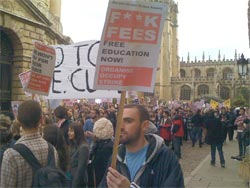
Students protesting against Vince cable (Photo J Pitman)

The NUS and leadership skills

Since the introduction of tuition fees by a Labour government, the NUS have largely been half-hearted in their opposition to fees. There have been some sizeable and angry protests in London in the past especially when fees were first introduced. This author went on many coaches to Londinium and broke through countless police lines in order to lay claim to the London streets in the name of free education.

But the campaign quickly became much like an annual chore that had to be organised to keep up appearances. The NUS leadership now have the chance to place themselves at the centre of opposition to the privatisation of HE. It needs to take a leaf out of the 'green shoots' of student protest recovery in France and coordinate campaigns with the trade unions much like the students have in Greece. The protests also need to be linked up with students in the FE colleges who are also being attacked with cuts in the Education Maintenance Allowance (EMA). Thousands of these students will be forced into Job Centres as the EMA is their lifeline into further education.

 Larger and more militant protests need to be organised if an effective opposition is to be built in order to drive back the Tory decimation of higher education and the social cleansing of poorer working class students from academia.


Repeat after me... 'I will pay my fees on time'


Free education for all

However, the argument needs to be put that the demand is for free education for students, not merely a cap on fees. The template for the future of Higher Education of the Cameron-Clegg variety can be seen in Africa with spiralling costs, increased fees, huge cuts across the board, larger class sizes and less staff. The process of de-industrialisation that was witnessed in the industrial sector during the early 1980s under the Thatcher administration is being replicated in HE with savage cuts to terms and conditions and the drive for staff to increase productivity. The claims made by politicians and parroted by TV news reporters that we simply cannot afford free education, is a lie. Britain struggled with a far higher budget deficit in the late 1940s and still managed to build the NHS and the Welfare State. It's simply an argument about priorities -  the priorities of profits or the priorities of needs and public goods.

Students..  they're about democracy fundamentally

Students have historically also been at the forefront of the process of democratisation. Witness the role of students in Tiananmen in 1989 and more recently in Iran where they have played a central role in framing the debate and forcing the ruling regime onto the defensive. Student protests have historically provided both a fertile medium in which new ideas can germinate in periods of intensification of class struggle. They can also act as the spark in igniting protests against cuts and austerity across the UK and beyond. The ghosts of May '68 still haunt the politicians and terrify our bosses... yes even at Salford!

A victory in securing free education would force the university system to become far more democratic in that it would provide opportunities for far greater numbers of working class people. Education should be a right for all students, not just some sort of almost 'natural right' or 'inalienable right' of the wealthy and privileged, who will have little problem finding the extra money to cover the costs of increased fees.